Kathmandu Kailash Tour - One of the most visit spiritual tour which is considered as one of the holiest place that one must visit. This package of 7 day program but if you are interested in to travel then you can extend (if possible). A journey full of adventure, temple and views of the mountain and lakes is the dream for many people.
- trip code:ABCT
- destination:Tibet
:
- "Sacred":Transformation
Trip Highlights
- Sacred Destination, as it is revered as the abode of Lord Shiva and a pilgrimage site.
- Sightseeing of holy lake Mansarovar.
- Breathtaking views of the Himalayas and Tibetan landscapes.
- Explore the Tibetan culture and interaction with the local communities.
- Visit different monasteries.
- Highest pass Dolma La pass at 5630 meters and 3-day challenging Kora trek.
- Participation in different rituals and bathing in Lake Mansarovar.
Overview
Mount Kailash, also known as Kailasa, Gang Tise, or Gang Rinpoche, is a sacred mountain located in the Ngari Prefecture of the Tibet Autonomous Region in China. It stands in the Gangdise Shan range of the Transhimalaya, on the western edge of the Tibetan Plateau, at an elevation of 6,638 meters. The mountain lies close to the western trijunction of China, India, and Nepal, making it geographically and culturally significant.
Mount Kailash is situated near two holy lakes, Lake Manasarovar and Lake Rakshastal. The region is also the source of four major rivers of Asia: the Indus, Sutlej, Brahmaputra, and Ghaghara. Because of this unique location, the area holds immense spiritual and ecological importance.
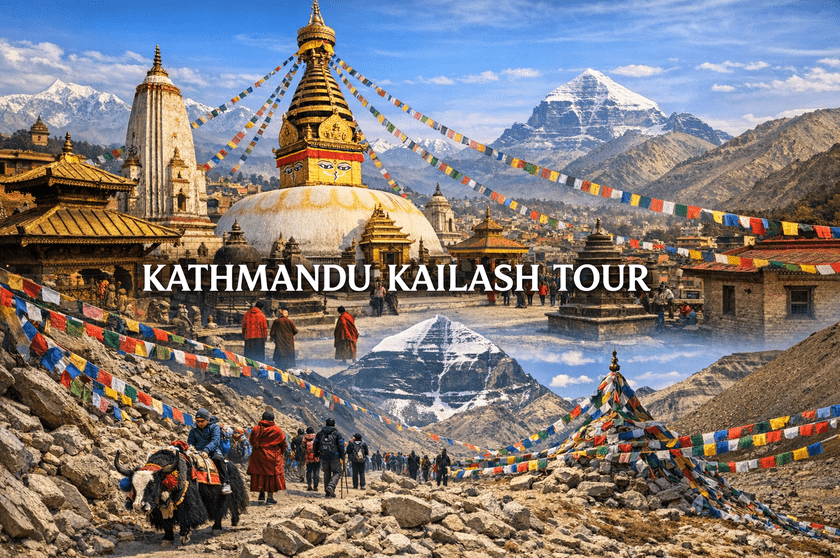
Revered in Hinduism, Buddhism, Jainism, and the ancient Bon religion, Mount Kailash is considered one of the most sacred pilgrimage sites in the world. Pilgrims from Nepal, India, China, and other countries travel to this remote region to perform the Kailash pilgrimage. The journey typically includes a trek to Lake Manasarovar followed by the Kailash Parikrama, a ritual circumambulation of the mountain.
Although Mount Kailash has been surveyed by climbers, there is no record of a successful ascent. Climbing the mountain is strictly prohibited by the Chinese government in respect of its deep religious and spiritual significance, preserving Mount Kailash tour as one of the few major peaks on Earth that remains untouched.
The main attractions of Tibet, holy Mt. Kailash and Mansarovar, are combined in this tour. The journey of the Kathmandu Kailash tour is a lifetime experience of places such as Paryanga, Mansarovar, and Lhasa and is considered a lifetime achievement in travel and tours. Exploration of unique and hidden treasure is allocated in this package from Global Nepal Treks. Since we are focusing our eye on a new but flexible destinations, this is one of those chosen places. We are pleased to serve you with the following itinerary.
The Kathmandu Kailash Tour Package encompasses a well-planned itinerary that includes pilgrims undertaking a holy trip toward Mount Kailash and Lake Mansarovar.
It can be competitive to start, at about $11.50, depending on the mode of travel and services. the Kathmandu Kailash tour cost is specifically prepared for all. The cost starts with the transportation option, which will vary with either flights, overlanding, or regular tourist buses to make the overall Kailash Tour from Nepal, which is the best.
History About Kailash Mansarovar
Mount Kailash and Lake Mansarovar, located in the remote southwestern region of Tibet (China), form one of the most sacred spiritual landscapes in the world. For thousands of years, this region has been revered by multiple religions, cultures, and civilizations, making it unique in global religious history.
Ancient Origins
The history of Kailash–Mansarovar dates back to prehistoric times. Ancient Tibetan texts and Indian scriptures describe the region as a divine center of the universe. Archaeological evidence suggests that nomadic tribes inhabited nearby areas as early as the Bronze Age, relying on the region’s rivers and grasslands.
Lake Mansarovar is believed to be one of the oldest freshwater lakes in Asia, formed by tectonic activity and glacial melt. Its pristine condition contributed to its reputation as a sacred and purifying body of water.
Significance in Hinduism
In Hindu tradition, Mount Kailash is considered the abode of Lord Shiva, one of the principal deities of the religion. According to the Puranas and the Ramayana, Lord Shiva resides on Mount Kailash with Goddess Parvati, practicing meditation.
Lake Mansarovar is believed to have been created by Lord Brahma, the creator of the universe. Ancient Hindu pilgrims believed that bathing in the lake cleansed all sins and that circumambulating Mount Kailash (known as Parikrama) led to liberation from the cycle of birth and death (moksha).
Importance in Buddhism
For Buddhists, Mount Kailash is sacred as the dwelling of Demchok (Chakrasamvara), a deity representing supreme bliss. Tibetan Buddhist texts regard the mountain as a spiritual axis of the world. The region gained prominence during the spread of Buddhism in Tibet (7th–9th century CE), when monasteries and pilgrimage routes were established.
Significance in Jainism
Jains believe Mount Kailash (known as Ashtapada) is the place where Rishabhadeva, the first Tirthankara, attained liberation. Jain scriptures from ancient India describe the mountain as a site of enlightenment and spiritual perfection.
Importance in Bon Religion
The indigenous Bon religion of Tibet predates Buddhism and considers Mount Kailash the sacred seat of the sky goddess Sipaimen. Bon followers perform circumambulation in the opposite direction to Buddhists, reflecting ancient ritual traditions.
Medieval and Trade History
During medieval times, Kailash–Mansarovar lay along important trade and pilgrimage routes connecting India, Tibet, and Central Asia. Pilgrims, monks, and traders traveled together, exchanging goods, culture, and ideas. Despite harsh conditions, the pilgrimage continued for centuries, supported by local Tibetan communities.
Modern History
In the 20th century, political changes in Tibet and the Himalayan region affected access to Kailash–Mansarovar. Today, the area is under Chinese administration, and pilgrimages are regulated. Despite modern borders and challenges, the spiritual importance of Kailash–Mansarovar remains undiminished.
Cultural and Spiritual Legacy
Unlike other sacred mountains, Mount Kailash has never been climbed, out of respect for religious beliefs. It stands as a symbol of spiritual unity, revered by Hindus, Buddhists, Jains, and Bon followers alike.
Best Time to Go Kailash Mansarovar
The best time to go to Kailash Mansarovar is during the summer months, when the weather is relatively stable and pilgrimage routes are open.
May to October (Ideal Time)
This is considered the best and safest period for the Kailash Mansarovar Yatra.
Why this period is best:
-
Snow melts and mountain passes open
-
Daytime temperatures are manageable
-
Roads and trekking routes become accessible
-
Official pilgrimage routes are operational
Month-wise overview:
-
May–June:
-
July–August:
-
September-October:
November to April (Not Recommended)
-
Extreme cold (temperatures drop below –20°C)
-
Heavy snowfall blocks routes
-
Pilgrimage and travel services are closed
Best Month Overall
June and October are often considered the best months due to stable weather and fewer disruptions.
Additional Tips
-
Acclimatization is crucial due to high altitude
-
Carry proper winter clothing even in summer
-
Check official government or tour operator schedules
-
Physical fitness is important for the Parikrama trek
Summary Table
| Season |
Months |
Suitability |
| Best |
May - October |
Ideal |
| Peak |
June-July |
Most Popular |
| Avoid |
November-April |
Unsafe |
Do's and Dont's for Kailash Mansarovar Tour
For the Buddhists, Hindus, Jains, and Bons, the Kathmandu Kailash Tour is the major pilgrimage tour. This Kathmandu Kailash Tour is provided to visit one of the most sacred place in the world, i.e. Mount Kailash and holy Lake Mansarovar. For this trek one must do the proper planning and preparation because the topography is rugged with hight altitude.
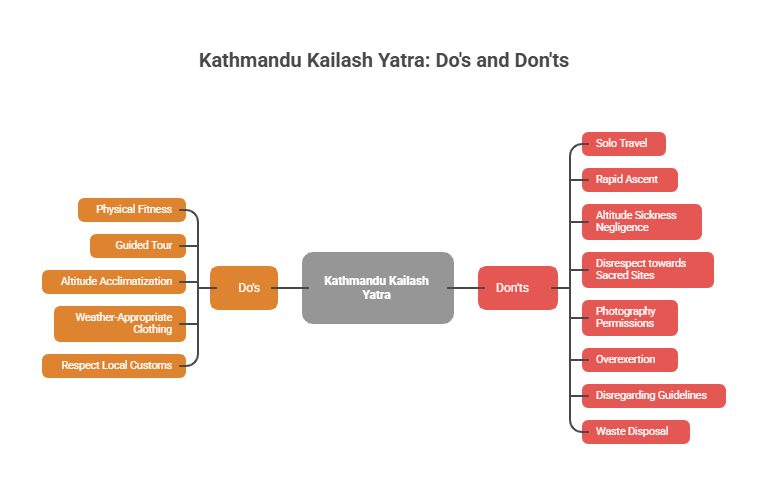
Do's
- Physical Fitness: You must be physically fit enough to walk to do Kora before starting the yatra. Regular exercise should be done, and a doctor should be consulted regarding your health status.
- Guided Tour: To make your tour a success with the best memories, join the best tour operator who has been organizing the tour and trek and has the best reviews.
- Altitude Acclimatization: This tour takes you to high altitudes, and to prevent altitude sickness, stay hydrated and avoid bad habits like smoking and drinking in the initial days.
- Weather-Appropriate Clothing: Provide warm and weather-appropriate clothes, as the weather in high-altitude areas can take a drastic turn within a moment. In such conditions, the layering of clothes will be helpful.
- Respect Local Customs: Respect the local customs, which call for dressing modestly, refraining from public displays of affection, and following local regulations.
Don'ts:
- Solo Travel: It is not advisable to travel alone because the difficult conditions and altitude can be dangerous. It is much safer to join an organized group.
- Rapid Ascent: One should not go up to higher altitudes rapidly. Allow your body to get acclimatized to the changing altitude so that altitude sickness can be avoided.
- Disrespect towards Sacred Sites: Respect the sacred sites that you visit. Follow any guidelines or restrictions that may relate to such areas.
- Photography Permissions: If you want to take a photo, then first get permission from the people and their things.
- Overexertion: Refrain from heavy exercises, especially during the first days of the trip. Take a rest for the high altitude.
- Disregarding Guidelines: Pay heed to and follow the guidelines provided by guides from tour operators. These guidelines mean your safety and well-being.
- Waste Disposal: Do not throw waste anywhere you want. Either carry the waste in your back or dispose of it in a proper place.
Things that you need to know
What is the Kathmandu Kailash Trek?
The Kathmandu Kailash Trek is a trekking route that takes you from the Kathmandu Valley to the sacred site of Kailashnath Mahadev, a revered Hindu temple dedicated to Lord Shiva, located in the Kavrepalanchok District of Nepal.
How long does the trek take?
The duration of the trek can vary depending on the specific route and itinerary chosen. On average, it takes around 4 to 6 days to complete the trek, but some longer or shorter options may be available.
What is the best time to do the Kathmandu Kailash Trek?
The best time to undertake the Kathmandu Kailash Trek is during the spring (March to May) and autumn (September to November) seasons when the weather is generally clear, and the temperatures are moderate. These seasons offer the best views of the surrounding landscapes.
What is the difficulty level of the Kathmandu Kailash Trek?
The trek is considered to be of moderate difficulty, suitable for trekkers with a reasonable level of fitness. While the trail involves some steep ascents and descents, it is generally well-defined, and no technical climbing skills are required.
Is it necessary to hire a guide or porter for the trek?
While it's not mandatory to hire a guide or porter for the Kathmandu Kailash Trek, many trekkers choose to do so for added convenience and support, especially if they are unfamiliar with the area or prefer not to carry heavy loads.
What permits are required for the Kathmandu Kailash Trek?
Trekkers will need to obtain the necessary permits from the respective local authorities, which may include entry permits for specific areas along the route. It's advisable to check with a local trekking agency or the Tourism Office in Kathmandu for the latest permit requirements.
What kind of accommodation is available along the trekking route?
Accommodation options along the Kathmandu Kailash Trek vary from basic teahouses and guesthouses to camping sites. Teahouses typically offer simple rooms with basic amenities such as beds and shared bathrooms, while camping allows for a more immersive outdoor experience.
What should I pack for the Kathmandu Kailash Trek?
Essential items to pack include sturdy trekking boots, appropriate clothing layers, a sleeping bag, trekking poles, a first aid kit, water purification tablets, sunscreen, a headlamp, and personal toiletries. It's important to pack according to the season and weather conditions.
Are there any health risks to be aware of during the trek?
Altitude sickness is a potential risk, especially at higher elevations. Trekkers are advised to acclimatize properly, stay hydrated, and ascend gradually to minimize the risk. It's also essential to be prepared for common ailments such as blisters, muscle strains, and insect bites.
Can I combine the Kathmandu Kailash Trek with other treks or activities?
Yes, the Kathmandu Valley offers numerous trekking and outdoor adventure opportunities, and it's possible to combine the Kathmandu Kailash Trek with other nearby treks or cultural excursions, such as visiting nearby temples or exploring traditional villages.
Always ensure you have adequate travel insurance and consult with local experts or trekking agencies for the most up-to-date information and advice before embarking on the Kathmandu Kailash Trek.


