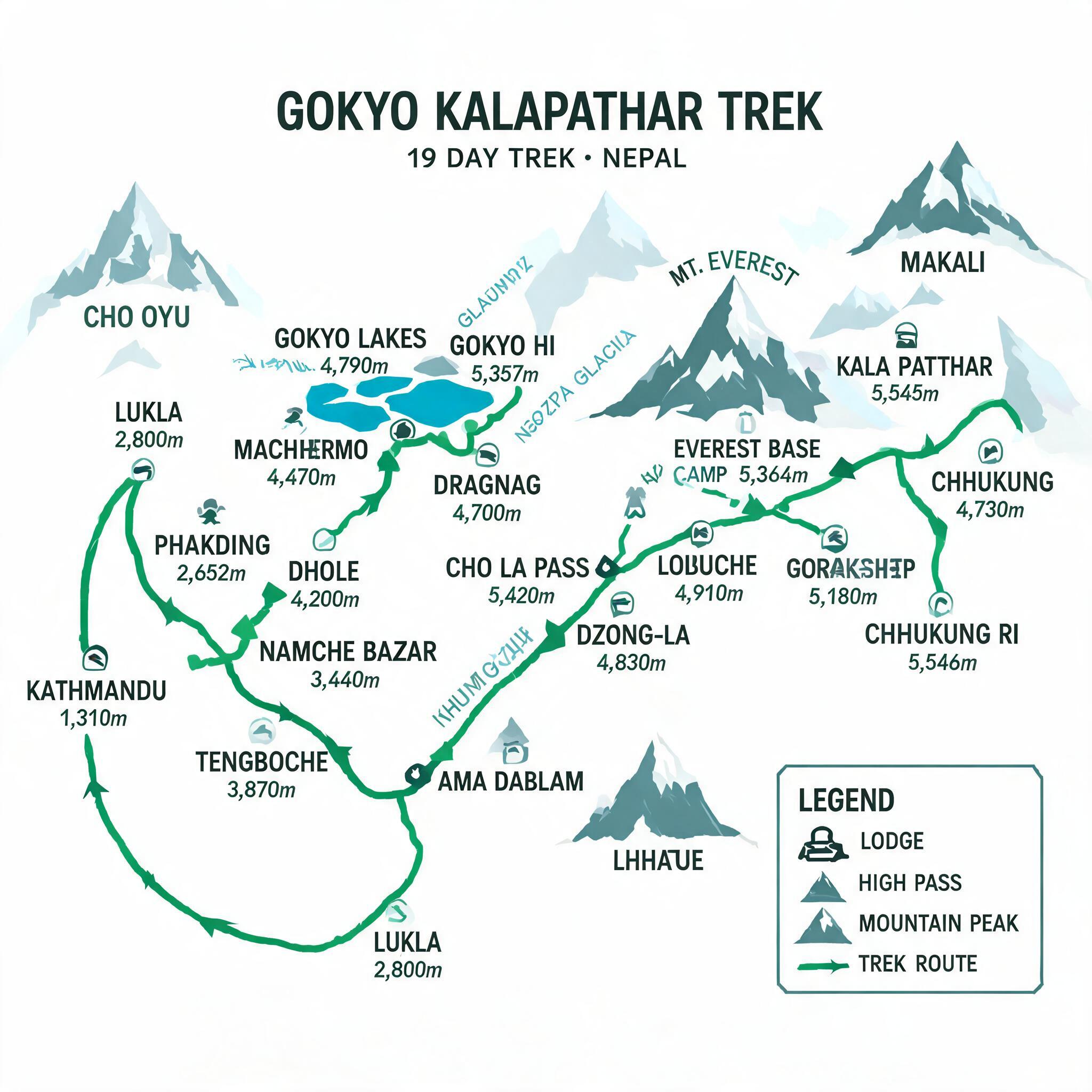
The Gokyo Kalapathar Trek is an adventurous and comprehensive Himalayan journey that masterfully combines the serene beauty of the Gokyo Valleys turquoise lakes, the challenge of crossing the high Cho La Pass, and the iconic thrill of reaching Everest Base Camp and Kala Patthar. This trek is ideal for experienced trekkers seeking a less crowded yet highly rewarding alternative to the classic Everest Base Camp route.
The journey begins with a thrilling flight to Lukla, followed by the classic trek through Sherpa villages like Phakding and the vibrant hub of Namche Bazaar. After acclimatization, the route diverges from the main trail, ascending into the pristine Gokyo Valley. Here, you'll be captivated by the stunning series of glacial lakes, offering breathtaking reflections of Cho Oyu and other Himalayan giants.
The trek's most challenging and exciting day is crossing the legendary Cho La Pass (5,420m), a high mountain pass linking the Gokyo Valley to the main Everest Base Camp trail. This demanding but rewarding crossing offers unparalleled views. The journey then continues through Lobuche and Gorakshep, culminating in an early morning ascent to Kala Patthar (5,545m) for the world's best sunrise view of Mount Everest, before visiting the base camp itself.
The trek also explores the eastern Everest region, including Chhukung and a rewarding hike to Chhukung Ri. The descent back through Tengboche, with its famous monastery, completes this unforgettable high-altitude adventure, blending remote landscapes, cultural richness, and legendary Himalayan viewpoints.
Things That You Need to Know
Duration & Difficulty:
The Gokyo Kalapathar Trek is a 19-day journey and is considered challenging. It requires excellent physical fitness, stamina, and ideally some previous high-altitude trekking experience due to the long duration, high altitude, and the demanding crossing of Cho La Pass.
Altitude:
The maximum altitude reached is Kala Patthar at 5,545 meters (18,192 feet). The trek also involves crossing Cho La Pass at 5,420m. Proper acclimatization, built into the itinerary, is absolutely critical.
Best Season:
The best times are Spring (March to May) and Autumn (September to November) for the clearest skies, most stable weather, and safest conditions for crossing the high pass.
Accommodation & Meals:
Accommodation is in comfortable tea houses or lodges in the villages along the route. The package includes three meals a day during the trek and hotel stays in Kathmandu with breakfast.
Permits Required:
You will need the Sagarmatha National Park entry permit and a TIMS (Trekkers Information Management System) card. These are included in our package and will be arranged for you.
Cho La Pass:
Crossing Cho La Pass is a major highlight and challenge. It requires good physical condition, proper acclimatization, and can involve traversing glacial terrain. Crampons may be needed depending on the season.
Gokyo Kalapathar Trek – 19 Days | Everest Region Adventure
Share
Highlights
• Thrilling mountain flight from Kathmandu to Lukla with breathtaking aerial Himalayan views.
• Trek through iconic Sherpa villages like Phakding, Namche Bazaar, and Tengboche.
• Comfortable overnight stays in charming villages including Dhole, Machhermo, Gokyo, and Lobuche.
• Visit the Everest View Point for spectacular panoramas and explore the Gokyo Valley's stunning turquoise glacial lakes.
• Cross the legendary and challenging Cho-La Pass (5,420m), one of the most adventurous high passes.
• Trek to Everest Base Camp, the dream destination for trekkers worldwide.
• Sunrise hike to Kala Patthar (5,545m) for the best Everest viewpoint of the entire region.
• Explore rich Sherpa culture, visit the peaceful Tengboche Monastery, and encounter Himalayan wildlife.
• Enjoy diverse terrain, from alpine meadows to rugged trails, glaciers, and high passes.
Detailed Itinerary
Day 1Altitude: 1310mTrekking: 0.0 hrs
Arrival in Kathmandu
Arrival at Kathmandu airport (1,310m). Welcome by Global Nepal Treks member and direct transfer to hotel on Bed & Breakfast plan.
Hotel in Kathmandu
Day 2Altitude: 2652mTrekking: 3.0 hrs
Fly to Lukla & Trek to Phakding
Early morning scenic flight to Lukla (2,800m). Begin trek to Phakding (2,652m) for approx. 3 hours, traversing scenic trails. Overnight at a lodge.
Lodge
Day 3Altitude: 3440mTrekking: 5.0 hrs
Trek to Namche Bazaar
Trek from Phakding to Namche Bazaar (3,440m). The trail winds through forests, crosses suspension bridges, and offers first views of Everest. Approx. 5 hours. Overnight in Namche.
Lodge
Day 4Altitude: 3440mTrekking: 2.0 hrs
Acclimatization Day in Namche
Rest and acclimatization day. Short hike to Everest View Point for panoramic views of Everest and surrounding peaks. Explore Namche Bazaar. Overnight in Namche.
Lodge
Day 5Altitude: 4200mTrekking: 5.0 hrs
Trek to Dhole
Trek from Namche Bazaar to Dhole (4,200m). The trail ascends through alpine landscapes, past grazing yaks. Approx. 5 hours. Overnight at a lodge.
Lodge
Day 6Altitude: 4470mTrekking: 4.0 hrs
Trek to Machhermo
Trek from Dhole to Machhermo (4,470m). Approx. 4 hours through diverse terrain with stunning mountain vistas. Overnight at a lodge.
Lodge
Day 7Altitude: 4790mTrekking: 5.0 hrs
Trek to Gokyo Lake
Trek from Machhermo to Gokyo Lake (4,790m). Approx. 5 hours, rewarded with breathtaking views of the turquoise lakes and surrounding peaks like Cho Oyu. Overnight at a lodge.
Lodge
Day 8Altitude: 4790mTrekking: 0.0 hrs
Explore Gokyo Valley & Gokyo Ri
Explore the Gokyo Valley. Optional early morning hike to Gokyo Ri (5,357m) for spectacular panoramic views of Everest, Makalu, and Cho Oyu. Overnight in Gokyo.
Lodge
Day 9Altitude: 4700mTrekking: 4.0 hrs
Trek to Dragnag
Trek from Gokyo to Dragnag (4,700m). Approx. 4 hours, moving closer to the base of Cho La Pass. Overnight at a lodge.
Lodge
Day 10Altitude: 4830mTrekking: 7.0 hrs
Cross Cho La Pass to Dzong-La
**Challenging day.** Early start to cross the legendary Cho La Pass (5,420m). Trek over glaciers and steep terrain to Dzong-La (4,830m). A demanding but incredibly rewarding 7-8 hour day. Overnight at a lodge.
Lodge
Day 11Altitude: 4910mTrekking: 4.0 hrs
Trek to Lobuche
Trek from Dzong-La to Lobuche (4,910m). Approx. 4 hours, with stunning views of towering peaks. Overnight at a lodge.
Lodge
Day 12Altitude: 5180mTrekking: 7.0 hrs
Trek to Gorakshep & Everest Base Camp
Trek from Lobuche to Gorakshep (5,180m). Continue to Everest Base Camp (5,364m) to witness the Khumbu Glacier and Icefall. Return to Gorakshep for the night. A long 7-8 hour day.
Lodge
Day 13Altitude: 4830mTrekking: 5.0 hrs
Kala Patthar Sunrise & Trek to Dzong-La
Pre-dawn hike to Kala Patthar (5,545m) for an unforgettable sunrise over Everest. Return for breakfast, then trek back to Dzong-La (4,830m). Overnight at a lodge.
Lodge
Day 14Altitude: 4730mTrekking: 4.0 hrs
Trek to Chhukung
Trek from Dzong-La to Chhukung (4,730m) via the Imja Khola valley. Approx. 4-5 hours. Overnight at a lodge.
Lodge
Day 15Altitude: 4730mTrekking: 0.0 hrs
Rest Day & Chhukung Ri Hike
Rest day in Chhukung. Optional hike to Chhukung Ri (5,546m) for incredible views of Ama Dablam, Lhotse, and Makalu. Overnight in Chhukung.
Lodge
Day 16Altitude: 3870mTrekking: 5.0 hrs
Trek to Tengboche
Trek from Chhukung back to Tengboche (3,870m), passing through Pangboche and descending through rhododendron forests. Approx. 5-6 hours. Visit the famous monastery.
Lodge
Day 17Altitude: 3440mTrekking: 5.0 hrs
Trek to Namche Bazaar
Trek from Tengboche back to Namche Bazaar (3,440m) through beautiful forests. Approx. 5 hours. Overnight in Namche.
Lodge
Day 18Altitude: 2860mTrekking: 6.0 hrs
Trek to Lukla
Final day of trekking from Namche Bazaar back to Lukla (2,860m). Descend through Phakding. Approx. 6-7 hours. Celebrate in Lukla. Overnight at a lodge.
Lodge
Day 19Altitude: 1310mTrekking: 0.0 hrs
Fly back to Kathmandu
Morning scenic flight back to Kathmandu. Transfer to your hotel. Free time to explore. Farewell dinner in the evening.
Hotel in Kathmandu
Inclusions & Exclusions
Included
Airport pick up & drops by private transport
Domestic flight from Kathmandu to Lukla and return
All ground transportation as per the itinerary
3 meals per day during the trek (Breakfast, Lunch, Dinner) including Tea or coffee
Accommodation in tea houses/lodges during the trek
3 Nights hotel accommodation in Kathmandu with breakfast
An experienced English-speaking trekking guide
Necessary porter (1 porter for 2 guests)
All Government local taxes
Sagarmatha National Park entry fees
Khumbu Pasang Lhamu Rural Municipality Permit
TIMS (Trekkers Information Management System) card
First Aid kit
Guide and porter salary
Guide and porter insurance during the trekking
Farewell dinner in Kathmandu
Excluded
Trekking equipment and any personal expenses (alcoholic beverages, phone usage, laundry)
Emergency Rescue and Travel Insurance (mandatory, highly recommended)
Trip Cancellation cost due to accident, health, loss, theft, or damage
Lunch and dinner in Kathmandu
Tips for guides, porters, and other service staff
Essential Information
Best Time to Visit
Spring (March–May) and Autumn (September–November) are the ideal seasons for the Gokyo Kalapathar Trek.
These months offer the clearest skies, most stable weather, and the safest conditions for crossing the high-altitude Cho La Pass (5,420m).
Winter (December–February) is possible but extremely cold; monsoon (June–August) brings heavy rain, poor visibility, and unsafe pass conditions.
October and November are peak months for crystal-clear Himalayan panoramas from Kala Patthar and Gokyo Ri.
Difficulty Level
Rated Challenging — one of the most demanding treks in the Everest region.
The 19-day itinerary involves long daily trekking hours (up to 7–8 hours on peak days), sustained high altitudes above 5,000m, and a glacier crossing at Cho La Pass (5,420m).
The Cho La Pass crossing (Day 10) is the single hardest day — involving steep glacial terrain, ice, and moraine that may require crampons.
Longer, more remote, and less crowded than the classic Everest Base Camp trek, making it more physically and mentally demanding.
Fitness Requirements
Excellent physical fitness and high stamina are essential — casual trekkers should not attempt this route without preparation.
Prior high-altitude trekking experience is strongly recommended, ideally above 4,000m.
Trekkers must be capable of walking 5–8 hours per day on steep, uneven, and glacial terrain for up to 19 consecutive days.
Strong cardiovascular endurance and leg strength are critical, especially for summit days at Kala Patthar (5,545m) and Cho La Pass (5,546m).
Preparation Tips
Begin a structured fitness program 6–8 weeks before departure — include cardio (running, cycling), leg strength training, and stair climbing with a loaded backpack.
Complete at least one prior trek above 3,500m to test your body's response to altitude before attempting this route.
Consult your doctor about Diamox (Acetazolamide) for altitude sickness prevention; carry it even if not taking it preventatively.
Practice gradual ascent discipline — follow the "climb high, sleep low" principle and never skip acclimatization days (Days 4 & 8 are built into the itinerary).
Stay hydrated — drink 3–4 liters of water daily at altitude; avoid alcohol especially in the first week.
Arrive in Kathmandu 1–2 days early to rest, adjust, and finalize gear before the Lukla flight.
Equipment List
Footwear: Sturdy waterproof trekking boots (ankle support), gaiters
Clothing: Thermal base layers, fleece mid-layer, down jacket, windproof/waterproof outer shell.
Sleeping: High-quality sleeping bag rated to -20°C
Trekking Gear: Trekking poles (essential for Cho La Pass), crampons (season-dependent).
Protection: High-SPF sunscreen (50+), UV-protection sunglasses, warm hat, balaclava, gloves.
Lighting: Headlamp with extra batteries (pre-dawn Kala Patthar ascent).
Hydration: Reusable water bottles, water purification tablets or filter.
Health: Personal first aid kit, altitude medication (Diamox), blister pads, lip balm.
Documents: Passport, insurance certificate, visa, 2 passport-size photos.
Optional: Camera, power bank, dry bags, solar charger
Health Considerations
Acute Mountain Sickness (AMS) is a serious risk — the trek reaches 5,545m at Kala Patthar and 5,420m at Cho La Pass; symptoms include headache, nausea, dizziness, and loss of appetite.
Acclimatization days are built into the itinerary (Namche Bazaar on Day 4; Gokyo Valley on Day 8) — never skip these, regardless of how you feel.
Your licensed guide will actively monitor all trekkers for AMS symptoms throughout the journey.
If symptoms worsen, immediate descent is the only safe remedy — emergency helicopter evacuation is available and covered by mandatory travel insurance.
UV radiation is intense at high altitude — sunscreen, lip balm, and UV-rated sunglasses must be used daily.
Cold temperatures can lead to frostbite and hypothermia at high camps — proper layering is critical, especially during pre-dawn summit attempts.
Safety Measures
All treks are led by experienced, licensed English-speaking guides from Global Nepal Treks who are trained in altitude first aid and emergency response.
Hiring a guide and porter is highly recommended — essential for navigation, glacier crossing safety at Cho La, and emergency support.
Comprehensive travel insurance is mandatory — must cover trekking at altitudes up to 5,600m, emergency helicopter evacuation, medical expenses, and trip cancellation.
The entire 19-day itinerary is structured for safe acclimatization with rest days specifically placed at altitude-sensitive points.
24/7 support from the Global Nepal Treks team throughout the journey; real-time weather monitoring before and during the Lukla flight.
In any emergency, helicopter rescue can be arranged rapidly from key points along the route, including Gorakshep, Lobuche, and Namche Bazaar.
Permits Required
PermitDetailsSagarmatha National Park Entry PermitRequired for all trekkers entering the Everest region. Khumbu Pasang Lhamu Rural Municipality Permit: Local municipality permit for Khumbu region access. TIMS card (Trekkers' Information Management System): mandatory for all trekkers in Nepal
✅ All three permits are included in the Global Nepal Treks Gokyo Kalapathar Trek package — arranged on your behalf.
Cultural Etiquette
Walk clockwise around all Buddhist stupas, chortens, mani walls, and prayer wheels — this is a deeply sacred directional practice in Sherpa culture.
Remove shoes and hats before entering monasteries, including the famous Tengboche Monastery visited on Day 16.
Ask permission before photographing monks, local Sherpa families, or any religious ceremony.
Lower your voice and avoid disruptive behavior inside and near monasteries and sacred sites.
Do not touch or step over mani stones or religious carvings along the trail — pass them on the left.
Dress modestly when visiting villages and monasteries — avoid short shorts, sleeveless tops, or revealing clothing.
Local Customs
The Sherpa people are the heartbeat of the Everest region — they revere the mountains as sacred deities; show deep respect for their land and traditions throughout the trek.
The Gokyo Lakes are considered sacred in both Hinduism and Buddhism — do not litter, wash, or pollute near the lake shores; these are among the highest freshwater lakes in the world.
Trekkers passing through Namche Bazaar (the Sherpa capital) may witness the vibrant Saturday market — a cultural highlight where Tibetan and Sherpa traders gather.
The Tengboche Monastery (3,870m) hosts important Buddhist festivals like Mani Rimdu (October/November) — if your trek coincides, attending is a rare and unforgettable cultural experience.
It is customary to offer tips to guides, porters, and tea house staff — this is an important part of local livelihood and is strongly encouraged by Global Nepal Treks.
The Sherpa greeting "Namaste" (hands pressed together) is universally used and deeply appreciated throughout the trek — use it warmly with every local you meet.
Frequently Asked Questions
What is the Everest Gokyo Kalapathar Trek?
The Everest Gokyo Kalapathar Trek is a comprehensive and adventurous trekking route in the Everest region. It combines the stunning turquoise Gokyo Lakes, the challenging Cho La Pass, Everest Base Camp, and the iconic sunrise viewpoint of Kala Patthar, offering a complete Himalayan experience away from the main crowds.
How long does the trek take?
This comprehensive trek typically takes around 18-20 days. Our detailed 19-day itinerary allows for proper acclimatization, exploration of the Gokyo Valley, crossing the Cho La Pass, and reaching the high points of EBC and Kala Patthar.
What is the difficulty level of the trek?
The trek is considered challenging. It requires excellent physical fitness, stamina, and ideally some previous high-altitude trekking experience due to the long duration, high altitudes, and the demanding crossing of Cho La Pass (5,420m).
What is the best time for this trek?
The best time is during Spring (March to May) and Autumn (September to November). These seasons offer the most stable weather, clearest skies, and safest conditions for crossing the high Cho La Pass.
What permits are required for the trek?
Trekkers need the Sagarmatha National Park Entry Permit, the Khumbu Pasang Lhamu Rural Municipality Permit, and a TIMS card. All these are included in our package.
What is the accommodation like during the trek?
Accommodation is primarily in comfortable tea houses or lodges found in all villages along the route. They provide basic amenities, a bed, blankets, and meals. The package also includes hotel stays in Kathmandu.
What are the major highlights of this trek?
Key highlights include the turquoise Gokyo Lakes, the challenging Cho La Pass crossing, Everest Base Camp, sunrise from Kala Patthar, views from Gokyo Ri and Chhukung Ri, the Sherpa culture, and the famous Tengboche Monastery.
Is it necessary to hire a guide and porter?
While not mandatory for experienced trekkers familiar with the region, hiring a guide and porter is highly recommended for safety, navigation, support in crossing the pass, and gaining deeper cultural insights. Our package includes both.
What is the altitude sickness risk, and how can it be prevented?
Altitude sickness is a significant risk on this trek due to the high altitudes. Prevention includes proper acclimatization (built into our itinerary), staying hydrated, ascending gradually, and listening to your body. Your guide will monitor everyone.
What should I pack for the Gokyo Kalapathar Trek?
Essential items include sturdy trekking boots, a high-quality sleeping bag, multiple warm layers (thermal, fleece, down jacket), a waterproof outer shell, trekking poles (essential for Cho La), headlamp, water bottles, high-SPF sunscreen, sunglasses, a hat, and a personal first aid kit.
Is travel insurance necessary for this trek?
Yes, comprehensive travel insurance is absolutely essential for this challenging trek. It must cover trekking at altitudes up to 5,600m, including emergency helicopter evacuation, medical expenses, and trip cancellation.
What is the Cho La Pass crossing like?
Crossing Cho La Pass (5,420m) is the most challenging day of the trek. It involves a steep climb over a glacier with moraine and ice, often requiring careful footing. It is physically demanding but offers spectacular and unforgettable views. Proper gear and acclimatization are crucial.
Can I see Mount Everest from Gokyo Ri?
Yes, Gokyo Ri (5,357m) offers a spectacular and unique panoramic view of four 8,000m peaks: Everest, Lhotse, Makalu, and Cho Oyu, along with the massive Ngozumpa Glacier and the turquoise Gokyo Lakes.
How does this trek compare to the classic Everest Base Camp trek?
This trek is longer, more challenging, and less crowded. It offers the added beauty and solitude of the Gokyo Valley and the thrill of crossing Cho La Pass, providing a more comprehensive and adventurous experience of the Everest region.
What are the Gokyo Lakes?
The Gokyo Lakes are a series of stunning, sacred, turquoise-colored oligotrophic lakes in the Everest region. They are among the highest freshwater lake systems in the world and are a breathtakingly beautiful highlight of the trek.