Introduction
Island Peak — known locally as Imja Tse — is the most popular trekking peak in Nepal and the perfect introduction to high-altitude Himalayan mountaineering. Standing at 6,189m in the heart of the Khumbu region, directly above the Everest Base Camp trekking route, Island Peak offers every fit and determined trekker a genuine summit experience at over 6,000m above sea level.
The name "Island Peak" comes from Eric Shipton's 1952 British Everest Expedition. When the team viewed the mountain from Dingboche, it appeared to float like an island above a sea of glacial ice — and the name has stayed ever since.
At Global Nepal Treks (Licence No. 3058) we have guided hundreds of trekkers to the summit of Island Peak since 2008. This is the most complete and honest Island Peak climbing guide available for 2026 — covering difficulty, cost, permits, training, best time, and our complete 18-day itinerary.
Quick facts:
Official name: Imja Tse
Altitude: 6,189m (20,305 feet)
Location: Khumbu region, Sagarmatha National Park
Duration: 18 days (combined with EBC Trek)
Difficulty: PD — Moderately Difficult
Price: From $2,250 per person all-inclusive
Best time: Spring (March–May) and Autumn (September–November)
Summit success rate: 65–70%
Prior climbing experience: Not required
Why Island Peak is the Perfect First Himalayan Summit
Island Peak is classified as a Nepal Mountaineering Association trekking peak — meaning it is accessible to non-technical climbers with proper preparation and certified guide support. It is not a walk — it is a genuine high-altitude mountaineering experience. But it does not require the years of technical training needed for 7,000m and 8,000m peaks.
Here is why Island Peak is the ideal first Himalayan summit for fit and motivated trekkers:
No prior climbing experience required. Your certified Global Nepal Treks Sherpa climbing guide teaches you all necessary technical skills — crampon use, ice axe technique, and Jumar fixed rope technique — during a full training day at Island Peak Base Camp (5,100m) the day before your summit attempt.
Built-in acclimatization. The 18-day itinerary combines the Everest Base Camp Trek (Days 1–11) with Island Peak climbing (Days 12–18). By the time you reach Island Peak Base Camp you have already spent 10 days acclimatizing up to 5,545m on the EBC route. This is the best possible preparation for a 6,189m summit.
Well-established route. The Island Peak climbing route has been used by thousands of trekkers since 1953. Fixed ropes are installed on the technical sections by guides before each climbing season. The route is well-marked, well-supported, and well-understood.
Maximum reward for the effort. The 360-degree summit view from Island Peak encompasses Lhotse (8,516m), Makalu (8,463m), Ama Dablam (6,812m), Baruntse (7,129m), and the entire Khumbu Valley. It is one of the most extraordinary panoramas available to non-technical climbers anywhere in the world.
Island Peak Difficulty — Honest Assessment
Island Peak is graded PD (Peu Difficile — Moderately Difficult) in standard alpine climbing grades. This is the truth about what that means:
What makes Island Peak challenging
Altitude. At 6,189m, you are operating at approximately 47% of the oxygen available at sea level. Even the fittest trekkers feel the impact. The summit day begins at midnight — 8–12 hours of continuous physical effort at extreme altitude in cold and darkness.
Summit headwall. The final 200–300m of the climb is a 40–50 degree snow and ice slope requiring Jumar technique on fixed ropes. This is the most technically demanding section. Your guide leads and fixes the rope — you follow using the Jumar device.
Glacier crossing. Between high camp and the summit headwall, you cross the Island Peak glacier. The glacier has crevasses — you move roped to your guide at all times. Fixed ropes guide the route through the glacier.
Cold. Summit night temperatures on Island Peak reach -15°C to -25°C with wind chill. Proper clothing — down suit, insulated boots, heavy gloves — is essential.
Exhaustion. By summit day you have already trekked for 14 days. Cumulative fatigue is real. The mental and physical strength to keep going at midnight at 5,600m when you are already tired is the defining challenge.
What makes Island Peak accessible
No rock climbing required. The route is entirely on snow, ice, and moraine. Rock climbing skills are not needed.
All technical skills taught at base camp. Your guide teaches crampon walking, ice axe use, and Jumar technique during a full day of training at base camp. Most trekkers are confident with these skills within 2–3 hours.
Fixed ropes throughout. The technical sections have fixed ropes installed by our guides before the summit day. You clip your Jumar to the rope and follow — the rope protects you from falling.
Guides support you every step. Your certified Sherpa climbing guide is with you on every metre of the climb. They have summited Island Peak dozens of times. They know exactly when to push and when to rest.
Technical Skills You Will Learn at Base Camp
Your certified Global Nepal Treks climbing guide runs a full technical training session at Island Peak Base Camp (5,100m) the day before the summit attempt. Here is exactly what you learn:
Crampon use
Crampons are metal frames with spikes that attach to your mountaineering boots. They grip snow and ice that would be impossible to walk on without them. Your guide teaches correct crampon attachment, walking technique on flat and steep terrain, and how to prevent crampon balling (snow clumping in the points).
Training time: 1–2 hours. Most trekkers are comfortable with crampons within 1 hour.
Ice axe technique
The ice axe is your primary safety tool on snow slopes. Your guide teaches correct carrying position, balance use on ascent, and most importantly — self-arrest technique (how to stop yourself if you slip on a snow slope). Self-arrest is the most important safety skill on any snow climb.
Training time: 1 hour. Self-arrest becomes instinctive with practice.
Jumar fixed rope technique
The Jumar is a mechanical device that slides up a fixed rope but locks when downward pressure is applied. On the summit headwall, you clip your Jumar to the fixed rope and use it as your primary safety attachment while ascending. Your guide demonstrates correct Jumar attachment, movement technique, and how to pass anchor points safely.
Training time: 1–2 hours on practice fixed rope set up near base camp.
Rope team movement
On the glacier crossing you are roped to your guide and other team members. Moving efficiently as a rope team — staying the right distance apart, moving in sync, responding to guide signals — is practiced on the approach to high camp.
Training time: 30 minutes. Rope team movement becomes natural quickly.
Island Peak Climbing — 18-Day Complete Itinerary 2026
Day 1 — Arrive Kathmandu (1,400m)
Arrive at Tribhuvan International Airport. Transfer to hotel in Thamel. Welcome dinner with your guide. Trek briefing, gear check, and permit verification. Meet your Sherpa climbing guide and porter team.
Day 2 — Kathmandu — Permits and Preparation
Morning visit to the Nepal Mountaineering Association to collect Island Peak climbing permit. Afternoon gear check — confirm all climbing equipment is complete. Visit Thamel gear shops for any missing items. Equipment rental arranged if needed (double boots, down suit, crampons).
Day 3 — Fly Kathmandu → Lukla (2,860m) · Trek to Phakding (2,610m)
Early morning flight to Tenzing-Hillary Airport Lukla — one of the world's most exciting mountain approaches. Trek 3–4 hours through the Dudh Koshi Valley to Phakding. First night in Khumbu tea house.
Day 4 — Phakding → Namche Bazaar (3,440m)
Trek 5–6 hours through pine forests, dramatic suspension bridges, and the Sagarmatha National Park checkpoint. Steep final ascent to Namche Bazaar — the capital of the Khumbu region. Excellent bakeries, gear shops, and your first big Himalayan views.
Day 5 — Namche Bazaar Acclimatization (3,440m)
Full rest day for acclimatization. Morning hike to Everest View Hotel (3,880m) — your first clear view of Everest (8,849m), Lhotse (8,516m), and Ama Dablam (6,812m). Afternoon at leisure. Guide monitors oxygen saturation with pulse oximeter.
Day 6 — Namche → Tengboche (3,867m)
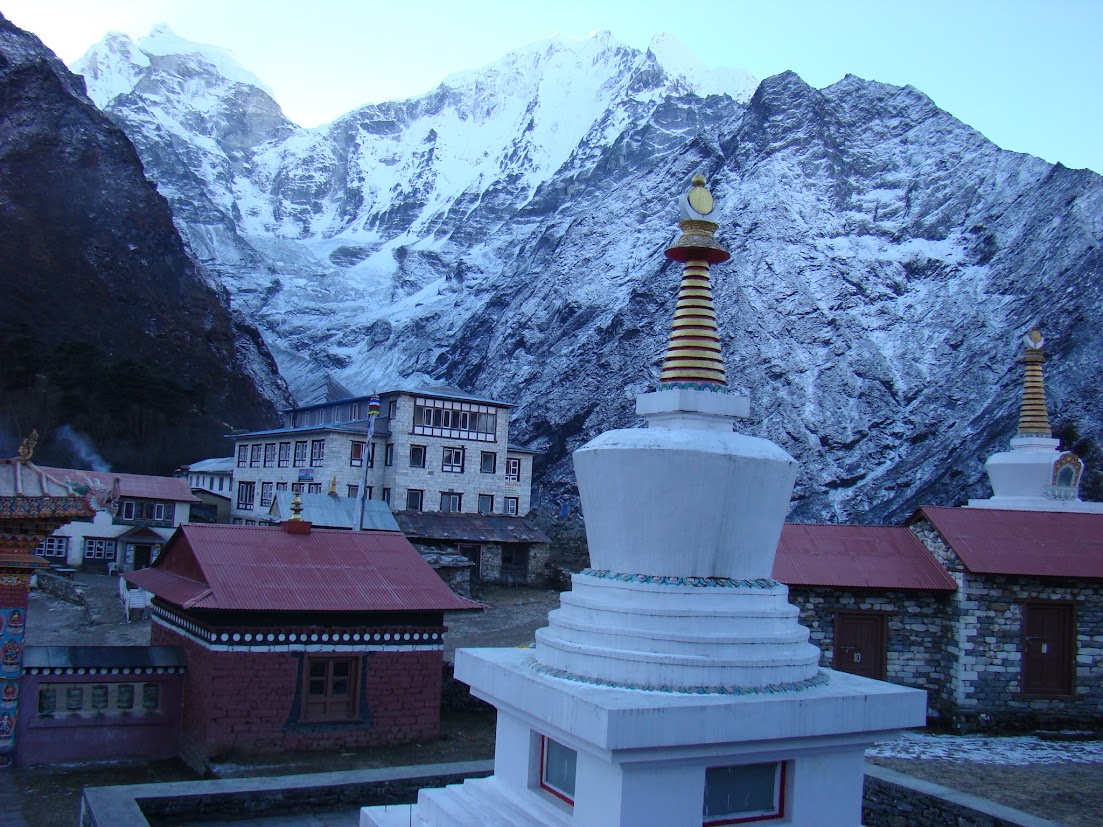
Trek 5–6 hours through rhododendron and birch forest with constant Ama Dablam views. Arrive at Tengboche — home to the most famous Buddhist monastery in the Khumbu Valley. Evening prayer ceremony with butter lamps and monk chanting if timing allows.
Day 7 — Tengboche → Dingboche (4,410m)
Trek 5–6 hours descending to Pangboche (visit the ancient Pangboche Monastery en route) then climbing to Dingboche — a wide open valley with dramatic Lhotse and Island Peak views. Island Peak is visible for the first time from Dingboche.
Day 8 — Dingboche Acclimatization (4,410m)
Second acclimatization day. Morning hike to Nangkartshang Hill (5,050m) for 360-degree views of Makalu, Lhotse, Ama Dablam, and Island Peak. Afternoon rest. Guide continues daily health monitoring.
Day 9 — Dingboche → Lobuche (4,940m)
Trek 4–5 hours past the Thukla memorial chortens — stone monuments to fallen Everest climbers. A profoundly moving passage. Arrive at Lobuche with Pumori and Nuptse filling the skyline.
Day 10 — Lobuche → Everest Base Camp (5,357m) → Gorak Shep (5,140m)
The most iconic day of the trek. Trek 3–4 hours to Everest Base Camp — the legendary starting point of all Everest summit attempts. Stand at the foot of the world's highest mountain. Return to Gorak Shep for overnight.
Day 11 — Kala Patthar (5,545m) → Descend to Chhukung (4,730m)
Pre-dawn start (4:30 AM) to summit Kala Patthar — the most famous Everest viewpoint in the world. Watch the first golden light hit Everest's summit pyramid. Descend all the way to Chhukung valley near Island Peak.
Day 12 — Chhukung → Island Peak Base Camp (5,100m)
Trek 3–4 hours from Chhukung to Island Peak Base Camp. Set up tent camp for the first time — tea house trekking ends here. Base camp has spectacular views of Island Peak's southeast ridge, Lhotse's south face, and Ama Dablam. Rest afternoon.
Day 13 — Technical Skills Training Day at Base Camp (5,100m)
Full day of technical climbing skills training with your certified Sherpa guide:
Morning: Crampon fitting and walking technique (1–2 hours)
Midday: Ice axe use and self-arrest practice (1 hour)
Afternoon: Jumar fixed rope technique on practice ropes (1–2 hours)
Evening: Summit day briefing — route, timing, weather check, emergency plan
This day is essential. Do not skip training even if you feel confident. Altitude changes everything.
Day 14 — Base Camp → High Camp (5,600m)
Trek 3–4 hours from base camp to high camp at 5,600m. Carry personal gear and sleeping equipment. High camp is a tent camp on a rocky plateau with direct views of the summit route. Rest and hydrate for tomorrow's summit attempt. Early dinner and sleep by 6:00 PM — midnight wake up call.
Day 15 — SUMMIT DAY — High Camp → Island Peak Summit (6,189m) → Base Camp
This is the day everything has been building toward.
12:00 AM–1:00 AM: Wake up. Hot tea. Final gear check. Crampons on.
1:00 AM–2:00 AM: Depart high camp. Headlamps on. Stars above.
1:00 AM–4:00 AM: Glacier crossing on fixed ropes. Guide leads. Team moves roped together.
4:00 AM–6:00 AM: Summit headwall — 40–50 degree slope. Jumar technique on fixed ropes. Most demanding section.
6:00 AM–7:00 AM: Summit (6,189m). Sunrise over Lhotse, Makalu, Baruntse, Ama Dablam. The most extraordinary view of your life.
7:00 AM–11:00 AM: Descent to base camp. Crampons on throughout. Guide descends last.
11:00 AM–2:00 PM: Rest at base camp. Hot meal. Celebrate with your Sherpa team.
Afternoon: Pack camp and descend to Chhukung tea house for the night.
Total summit day time: 12–16 hours. The most demanding and rewarding day of your life.
Day 16 — Chhukung → Namche Bazaar (3,440m)
Long descent — 6–7 hours. Your body recovers as oxygen increases. Arrive Namche for celebration dinner. Toast your summit with your guide and porter team.
Day 17 — Namche → Lukla (2,860m)
Final trekking day. Descent through familiar landscapes — rhododendron forest, suspension bridges, Dudh Koshi Valley. Arrive Lukla for final celebration dinner. Tips given to guide, assistant guide, and porter.
Day 18 — Fly Lukla → Kathmandu · Farewell Dinner · Departure
Early morning flight back to Kathmandu. Transfer to hotel. Free time for shopping in Thamel. Evening farewell dinner. Transfer to international airport for departure.
Island Peak Cost 2026 — Complete Breakdown
Global Nepal Treks Island Peak Package — From $2,250 per person
What is included
✅ 18-day complete itinerary — EBC Trek + Island Peak climbing
✅ NTB licensed and NMA certified Sherpa climbing guide throughout
✅ Licensed trekking guide for EBC approach days
✅ Porter — 1 per 2 trekkers
✅ All accommodation — 3-star hotel Kathmandu (Days 1–2, 18) + tea houses (Days 3–12, 16–17) + high altitude tents (Days 13–15)
✅ All meals — breakfast, lunch, dinner every day throughout
✅ All permits — Island Peak climbing permit ($250), Sagarmatha National Park ($30), TIMS ($20)
✅ Domestic Kathmandu–Lukla–Kathmandu flights (return)
✅ All airport and hotel transfers in Kathmandu
✅ Technical climbing equipment — ropes, snow pickets, ice screws (group equipment)
✅ Technical skills training day at base camp
✅ Oxygen and first aid kit (group emergency equipment)
✅ 24/7 emergency support from Kathmandu office
What is not included
❌ International flights to Kathmandu
❌ Nepal visa ($30 for 15 days, $50 for 30 days — on arrival at Kathmandu Airport)
❌ Travel insurance — mandatory, must cover helicopter evacuation to 6,500m and mountaineering
❌ Personal climbing equipment — double mountaineering boots, down suit, personal crampons, ice axe (rental available in Kathmandu)
❌ Tips — guide ($15–20/day), assistant guide ($10–12/day), porter ($8–10/day) — recommended $400–500 total for 18 days
❌ Personal spending — hot showers, Wi-Fi, device charging, snacks, drinks above included meals
❌ Lukla flight delay costs — accommodation and meals during weather delays (covered by travel insurance)
Climbing equipment rental — Kathmandu prices 2026
Item | Rental per day | 18-day cost |
Double mountaineering boots | $15–20 | $270–360 |
Down suit | $15–20 | $270–360 |
Personal crampons | $3–5 | $54–90 |
Ice axe | $2–3 | $36–54 |
Harness | $2–3 | $36–54 |
Helmet | $2–3 | $36–54 |
Full equipment rental | $40–55/day | $720–990 |
Global Nepal Treks provides all group technical equipment. Personal items (boots, down suit, clothing) you bring from home or rent in Kathmandu.
Price by group size
Group size | Price per person |
1 person — private | $2,800 |
2 people | $2,500 |
3–4 people | $2,250 |
5–8 people | $2,100 |
9+ people | $1,950 |
Total trip budget — Island Peak 2026
Item | Cost |
Global Nepal Treks package | $2,250 |
Nepal visa (30 days) | $50 |
Travel insurance (mountaineering) | $150–200 |
Equipment rental (full set, 18 days) | $720–990 |
Tips — guide + porter + assistant | $400–500 |
Personal spending on trail | $150–200 |
Total estimated budget | $3,720–4,290 |
Island Peak Permits 2026
Permit | Cost | Issued by | Arranged by |
Island Peak climbing permit | $250 (spring/autumn) | Nepal Mountaineering Association (NMA) | Global Nepal Treks |
Sagarmatha National Park | $30 | Nepal Government | Global Nepal Treks |
TIMS card | $20 | TAAN/NTB | Global Nepal Treks |
Garbage deposit (refundable) | $500 per group | NMA | Global Nepal Treks |
All permits are included in the Global Nepal Treks package price. You do not need to visit any government office yourself.
Important 2026 note: Island Peak climbing permits must be obtained through a licensed trekking agency — individual applications are not accepted. Global Nepal Treks (NMA member, Licence No. 3058) processes all permits as part of your package.
Best Time to Climb Island Peak in 2026
Spring — March to May ✅ Excellent
Spring is one of the two best seasons for Island Peak. March and April offer stable weather, good snow conditions on the summit slope, and rhododendron forests in bloom on the lower trail approach.
March: Excellent — stable weather, some fresh snow on the summit
April: Best month — stable, clear, ideal snow conditions
May: Good — pre-monsoon warming, summit snow softening
Our recommendation for spring: Book April departure for the best combination of stable weather and summit snow conditions.
Summer/Monsoon — June to August ❌ Not Recommended
Heavy monsoon rain below 4,000m makes the approach trail difficult. Above 4,500m, the glacier becomes unstable with fresh snowfall. Avalanche risk increases. Island Peak climbing is not recommended during monsoon season.
Autumn — September to November ✅ Best Season
Autumn is the most popular season for Island Peak — and for good reason. Post-monsoon crystal clear skies, perfectly consolidated snow on the summit slope, and the most stable weather of the year combine to create ideal conditions.
September: Good — trail recovering from monsoon, some residual cloud
October: Best month — crystal clear skies, perfect snow, stable weather, peak season energy
November: Excellent — clear skies, cold but stable, less crowded than October
Our recommendation for autumn: October is the single best month for Island Peak climbing. Book early — October spots fill up by June.
Winter — December to February 🟡 Experienced Climbers Only
Winter Island Peak is possible for experienced cold-weather climbers. Temperatures at summit reach -30°C to -35°C with wind chill. Summit snow is hard and icy — requires excellent crampon technique. Not recommended for first-time climbers.
Island Peak Physical Training Plan — 3 Months
Start this training plan exactly 3 months before your Island Peak departure date:
Month 1 — Build Base Fitness
Goal: Establish cardiovascular base and leg strength
Weekly routine:
Walk 5–8 km daily with 8–10 kg daypack
Stair climbing 20 minutes daily with pack — this specifically trains Island Peak muscles
Squats: 4 sets of 25 daily — essential for crampon walking and summit headwall
Lunges: 3 sets of 15 per leg daily
Swimming or cycling 3x per week for cardiovascular fitness
Reduce alcohol to minimum — start clean now
Month 2 — Build Endurance
Goal: Simulate consecutive trekking days with increasing load
Weekly routine:
Long hike 20–25 km with 12 kg pack — every weekend
Back-to-back hiking days — Saturday AND Sunday every weekend
Stair climbing 30 minutes daily — add weight progressively
Core strength: plank 3 × 60 seconds, mountain climbers 3 × 30 — daily
Yoga or stretching 20 minutes daily — flexibility prevents injury
Zero alcohol — serious preparation begins now
Month 3 — Peak Preparation and Taper
Goal: Peak fitness then rest before departure
Week 9–10:
Longest hike: 30 km with 14 kg pack
3 consecutive hiking days to simulate trek fatigue
Continue strength training
Week 11–12:
Reduce to moderate daily walks — recovery is as important as training
Focus on sleep — 8 hours per night mandatory
Finalise all gear — break in your mountaineering boots with 50+ km hiking
Take Diamox trial dose (consult your doctor) to check for side effects
Final medical check with your doctor
The most important physical preparation: Your legs must be strong enough to climb for 12–16 consecutive hours with crampons on snow and ice at 5,600–6,189m altitude. Stair climbing with a heavy pack every day for 3 months is the single most specific training exercise available.
Medical Preparation for Island Peak
Before you leave home
Complete medical check — include cardiovascular assessment, blood pressure, lung function
Altitude sickness history — discuss with your doctor if you have experienced AMS before
Diamox prescription — altitude sickness prevention medication, strongly recommended for Island Peak
Dental check — tooth problems at 6,000m are extremely difficult to manage
Eye check — vision can be affected at extreme altitude
Vaccinations — Hepatitis A, Typhoid, Tetanus
Travel insurance — mandatory requirements for Island Peak
Your travel insurance MUST cover:
Helicopter evacuation to 6,500m altitude minimum
Mountaineering activities up to 6,500m
Trip cancellation and delay
Medical costs in Nepal
Standard travel insurance does not cover mountaineering. You need a specialist policy. Companies offering Nepal mountaineering coverage: World Nomads, Battleface, IMG Global, True Traveller.
Without adequate insurance — a helicopter evacuation from Island Peak can cost $8,000–15,000 USD. This is not optional.
Altitude sickness on Island Peak — what to know
Altitude sickness (AMS) can affect anyone regardless of fitness level. The Island Peak route includes scheduled acclimatization days at Namche Bazaar (3,440m) and Dingboche (4,410m) specifically to reduce AMS risk.
Symptoms to watch for:
Persistent headache
Nausea and vomiting
Dizziness at rest
Loss of appetite
Difficulty sleeping
Shortness of breath at rest (not during activity)
Critical rule: Never ascend with active AMS symptoms. Tell your guide immediately. Descent is always the correct treatment for worsening symptoms.
HACE and HAPE (severe altitude conditions) are medical emergencies requiring immediate helicopter evacuation. Your guide carries pulse oximeters, supplemental oxygen, and portable altitude chamber (Gamow bag) for emergency use.
Summit Success Rate — Honest Numbers
Approximately 65–70% of trekkers who attempt the Island Peak summit reach the top. The main reasons for not summiting:
Reason | Percentage of failures |
Altitude sickness — AMS | 40% |
Extreme cold and wind | 25% |
Physical exhaustion | 20% |
Technical difficulty | 10% |
Weather — whiteout or storm | 5% |
Global Nepal Treks summit success rate is higher than average — because of our strict acclimatization schedule, experienced certified guides, and conservative turnaround time policy. We never push trekkers beyond safe limits for the sake of a summit.
If you do not summit — this does not mean failure. The Island Peak Base Camp experience alone, combined with the EBC Trek, is one of the most extraordinary Himalayan journeys available. The summit is the goal — not the only measure of success.
Island Peak vs Mera Peak — Which to Climb First?
Factor | Island Peak (6,189m) | Mera Peak (6,476m) |
Altitude | 6,189m | 6,476m |
Technical difficulty | Moderate — PD | Easy — F (Facile) |
Summit headwall | ✅ Yes — 40–50 degree slope | ❌ No — gentle walk-up |
Glacier crossing | ✅ Yes | ✅ Yes |
Fixed rope required | ✅ Yes | ❌ Usually not |
Acclimatization required | EBC Trek approach — excellent | Dedicated acclimatization trek |
Duration | 18 days combined with EBC | 18–21 days |
Price Global Nepal Treks | From $2,250 | From $2,100 |
Best for | Trekkers who have done EBC | Absolute beginners to climbing |
Views from summit | ✅ Lhotse, Makalu, Baruntse, Ama Dablam | ✅ Everest, Lhotse, Cho Oyu, Makalu |
Our recommendation: If you have completed or are planning the EBC Trek — combine it with Island Peak. The acclimatization is already built in, and the combination is the most complete Khumbu experience available.
If you have never trekked above 5,000m before — do Mera Peak first. Its gentle summit slope is more forgiving for first-time climbers.
Frequently Asked Questions — Island Peak Climbing 2026
Q: Do I need prior climbing experience to attempt Island Peak?
No. Prior technical climbing experience is not required. All necessary skills — crampon use, ice axe technique, and Jumar fixed rope technique — are taught by your certified Sherpa guide during a full training day at Island Peak Base Camp (5,100m). What you do need is good physical fitness and prior high-altitude trekking experience above 4,500m — ideally the EBC Trek combined in the same itinerary.
Q: What is the summit success rate on Island Peak?
Approximately 65–70% of trekkers who attempt the summit reach the top. Global Nepal Treks has a higher-than-average success rate due to strict acclimatization scheduling, certified experienced guides, and conservative turnaround policies. The most common reason for not summiting is altitude sickness — which is why we never rush the acclimatization schedule.
Q: What if I cannot reach the summit?
Not summiting is not failure. If your guide determines it is unsafe to continue — due to altitude sickness, extreme weather, or exhaustion — descent is the correct and honourable decision. The Island Peak Base Camp experience combined with the EBC Trek is itself one of the greatest Himalayan adventures available. Your safety is always the priority.
Q: Can I do Island Peak without doing the EBC Trek first?
Technically yes — there is a shorter approach directly from Chhukung without the EBC detour. However, we strongly recommend the combined EBC + Island Peak itinerary because the EBC approach provides essential acclimatization time above 5,000m that dramatically increases your summit success rate and safety.
Q: What double boots do I need for Island Peak?
You need insulated double mountaineering boots rated to at least -30°C — NOT regular trekking boots. The glacier and summit are extremely cold. Recommended brands: Scarpa Phantom 6000, La Sportiva Nepal Evo, Koflach Arctis. All are available for rent in Kathmandu ($15–20 per day).
Q: Is a down suit required?
Yes — a down suit is essential for the summit night and high camp. Temperatures reach -25°C to -35°C with wind chill above 5,600m. A regular down jacket is insufficient. Down suits are available for rent in Kathmandu ($15–20 per day).
Q: How do I get from Kathmandu to Lukla?
By domestic flight — 35–45 minutes from Tribhuvan International Airport to Tenzing-Hillary Airport (Lukla). During peak season (March–May and September–November) flights often operate from Ramechhap Airport (4–5-hour drive from Kathmandu, then 25-minute flight to Lukla). Global Nepal Treks arranges all Lukla flight bookings and Ramechhap jeep transfers as part of your package.
Q: What is the garbage deposit?
The Nepal Mountaineering Association requires a $500 garbage deposit per climbing group — refunded when you return with the required amount of waste from your climb. This policy exists to combat the litter problem on Nepal's climbing routes. Global Nepal Treks manages this deposit and return on your behalf.
Q: How large are the climbing groups on Island Peak?
Global Nepal Treks keeps Island Peak groups small — maximum 8 trekkers per group. Small groups allow more personal attention from your guide, better tent space at high camp, and faster movement on the summit headwall fixed ropes.
Q: What altitude does Island Peak reach and is it dangerous?
Island Peak summit is 6,189m (20,305 feet) above sea level. At this altitude oxygen levels are approximately 47% of sea level. The main dangers are altitude sickness, crevasse fall on the glacier (mitigated by roped team movement), frostbite (mitigated by proper clothing), and fall on the summit headwall (mitigated by fixed ropes and guide supervision). Global Nepal Treks guides are trained in all risk mitigation and carry emergency equipment throughout.
Q: Can I combine Island Peak with Mera Peak in one trip?
Yes — a combined Mera Peak and Island Peak expedition is possible in 24–28 days. This requires crossing the Amphu Laptsa Pass (5,780m) — a serious technical undertaking requiring prior climbing experience. Contact us for details on the combined Mera-Island Peak expedition.
Why Book Island Peak Climbing with Global Nepal Treks
Factor | Global Nepal Treks |
NTB Licence | No. 3058 — verified |
NMA Member | ✅ Active — required for Island Peak permits |
TAAN Member | ✅ Active |
Years operating | 15+ years since 2008 |
Island Peak ascents | 200+ successful summits guided |
Climbing guides | NMA certified and IFMGA trained |
Emergency equipment | Pulse oximeters, supplemental oxygen, Gamow bag, satellite phone |
Summit success rate | Above Nepal average — 70%+ |
All permits included | ✅ Island Peak + Sagarmatha NP + TIMS |
Technical equipment | ✅ All group gear provided |
24/7 emergency support | ✅ Kathmandu emergency coordinator |
Reviews | TripAdvisor + Trustpilot + Google — all verified |
Location | Bikramshila Mahavihar, Tham Bahee Road, Thamel, Kathmandu |
"First time trekker? Read our EBC Trek for Beginners guide"
October 2026 spots are filling fast. Spring 2027 bookings now open.
To book or enquire:
📧 info@globalnepaltreks.com
📞 +977-9744258519 / +977-9821274866
🌐 Ready to climb Island Peak? View our 18-day Island Peak expedition.