The Ultimate Nepal Trekking & Tour Guide 2025/2026
Best Packages, Routes & Everything You Need to Know
Nepal is one of the most extraordinary destinations on earth. Home to eight of the world's fourteen 8,000-metre peaks, ancient pilgrimage trails, and cultures that have remained largely unchanged for centuries, it offers something no other country can: a journey that changes you from the inside out.
But with so many trekking routes, tour packages, and regions to choose from, planning a trip to Nepal can feel overwhelming. Where do you start? How difficult are the treks? What's included? How much does it cost?
This guide answers all of that — drawn from the experience of our Sherpa guides and trekking experts at Global Nepal Treks, a government-licensed agency (Licence No. 3058) based in Kathmandu and associated with Nepal Tourism Board (NTB) and TAAN.
Let's start from the beginning.
Why Trek or Tour in Nepal?
Nepal punches far above its size. Within a single week, you can fly over the Himalayas at sunrise, walk through rhododendron forests to a monastery that's been standing for 500 years, share butter tea with a Sherpa family, and stand on a high mountain pass at 5,400 metres with the roof of the world laid out before you.
The trekking infrastructure — teahouses, trained guides, well-marked trails — is among the best-developed in the world. And unlike some Himalayan destinations, Nepal remains accessible to travellers of all backgrounds. You don't need to be an athlete. You need curiosity, reasonable fitness, and the right planning.
Here's a breakdown of Nepal's best packages for 2025–2026.
1. Everest Base Camp Trek — Nepal's Most Iconic Journey
Duration: 15 Days | Max Altitude: 5,545m | Difficulty: Moderate | Price: From $1,100/person
If there is one trek in Nepal that needs no introduction, it is the Everest Base Camp Trek. Standing at the foot of the world's highest mountain — Mount Everest at 8,848 metres — is a life moment that is genuinely impossible to replicate anywhere else on earth.
What to Expect
The trek begins with a thrilling 35-minute mountain flight from Kathmandu to Lukla (2,828m), the gateway to the Khumbu region. From there, the trail winds through pine-forested valleys and traditional Sherpa villages — Phakding, Namche Bazaar, Tengboche, Dingboche, and Lobuche — each one a little higher than the last, each one more dramatically beautiful.
The itinerary is built around proper acclimatization. A full rest day in Namche Bazaar (3,440m) — the bustling hub of the Khumbu — allows your body to adapt while your mind absorbs the extraordinary mountain panorama above town. There's a weekly market here, excellent bakeries, and a compelling Sherpa museum that puts the entire Himalayan world into context.
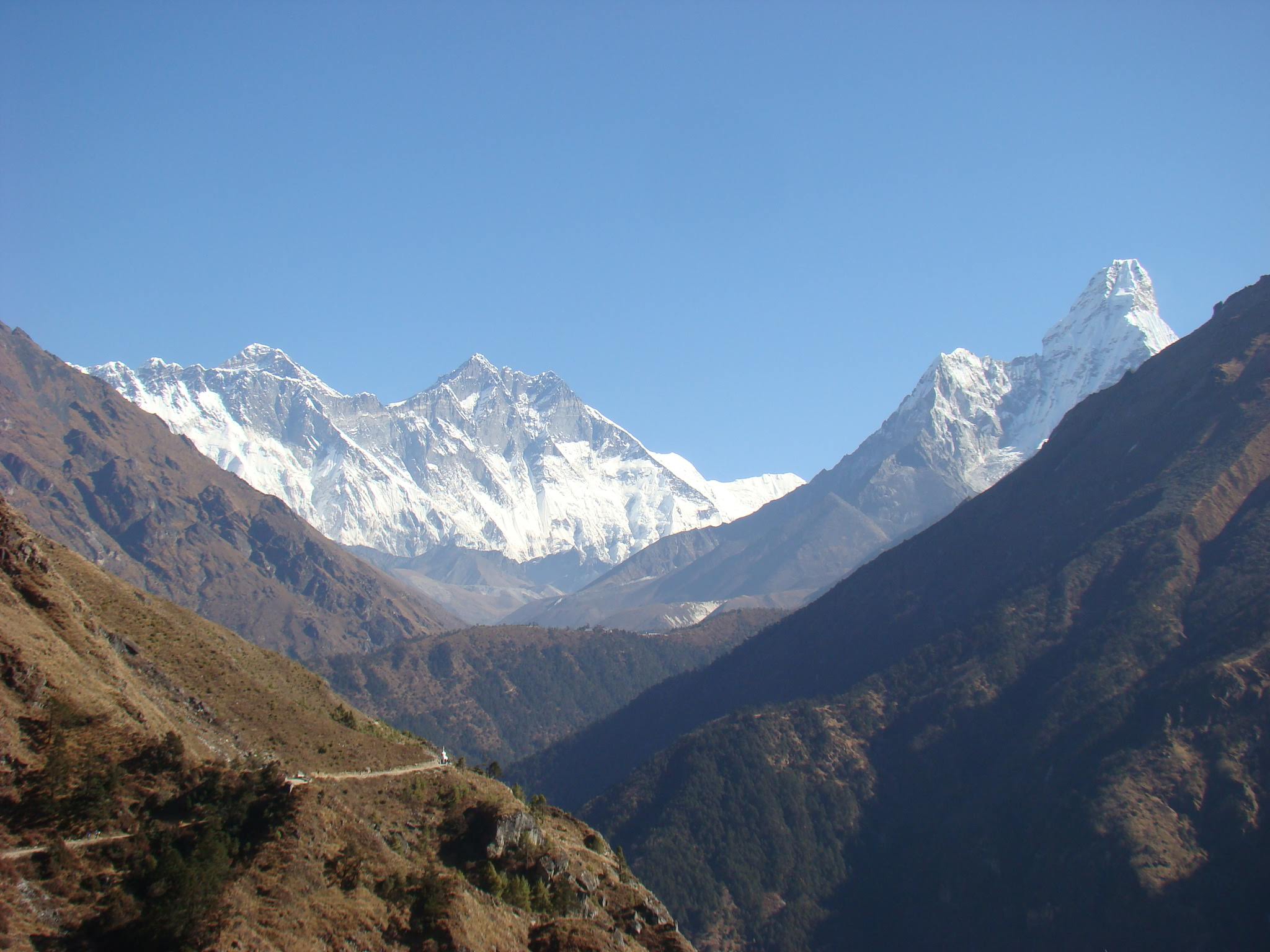
The emotional climax of the trek comes in two parts. First: arriving at Everest Base Camp (5,357m), where you stand beneath the thundering Khumbu Icefall, looking up at the mountain's Southwest Face — the same wall of ice and rock that every Everest climber must navigate. Second: the pre-dawn climb to Kala Patthar (5,545m), where the summit of Everest appears above you in the first light of morning, with Lhotse, Nuptse, Makalu, Ama Dablam, and Pumori arranged around you in a panorama that no photograph fully captures.
Who Is It For?
The Everest Base Camp Trek is designed for adventurous travellers who are reasonably fit but don't need prior trekking experience. Our itinerary builds acclimatization days in at every critical altitude point, and our guides carry pulse oximeters to monitor your oxygen levels throughout.
Groups are kept small — maximum 12 trekkers — ensuring personalised support from your guide every step of the way.
View Full Everest Base Camp Trek Details →
2. Annapurna Circuit Trek — The World's Greatest Trekking Route
Duration: 14 Days | Max Altitude: 5,416m | Difficulty: Challenging | Price: From $1,150/person
While the Everest Base Camp trek is Nepal's most famous, many experienced trekkers consider the Annapurna Circuit to be the finest trek on earth. The reason is diversity. In 14 days, you walk through sub-tropical forests, rice paddies, oak and rhododendron forests, high alpine meadows, and finally into a stark Tibetan-style landscape — all while the Annapurna and Dhaulagiri massifs tower above you.
The Thorong La Crossing
The centrepiece of the circuit is the Thorong La Pass (5,416m) — one of the highest trekking passes in the world. The crossing begins at 3–4am in complete darkness, headtorches picking out the trail as you ascend through cold, thin air for several hours. And then the pass opens up, the sun rises over the surrounding giants, and you're standing at 5,416 metres with an entire world of mountains around you.
The descent brings you down to Muktinath (3,800m), one of the most sacred pilgrimage sites in all of Asia — a place of deep significance for both Hindus and Buddhists.
The Kali Gandaki Gorge
Few natural formations on earth match the Kali Gandaki Gorge for sheer scale. The deepest gorge in the world, it runs between Dhaulagiri (8,167m) and Annapurna I (8,091m) — two 8,000-metre giants separated by less than 40 kilometres. Walking through it is one of the most humbling experiences Nepal offers.
View Full Annapurna Circuit Trek Details
3. Annapurna Base Camp Trek — A Shorter but Spectacular Alternative
Duration: 12–14 Days | Max Altitude: 4,130m | Difficulty: Moderate
For those who want the drama of the Annapurna massif without the challenge of Thorong La, the Annapurna Base Camp Trek delivers an extraordinary experience at a more manageable altitude.
The trail leads directly into the heart of the Annapurna Sanctuary — a natural amphitheatre ringed by Annapurna I (8,091m), Annapurna South, Machapuchare (the sacred "Fishtail" peak), Hiunchuli, and Gangapurna. Reaching Annapurna Base Camp at 4,130m and looking up at these peaks from directly below is as powerful a mountain experience as the Himalayas offer.
4. Muktinath Tour — A Sacred Pilgrimage Beyond the Himalayas
Duration: 8 Days | Max Altitude: 3,802m | Difficulty: Easy to Moderate | Price: From $1,000/person
Not every journey to Nepal needs to be a physical challenge. The Muktinath Tour is Nepal's premier spiritual pilgrimage — a journey to one of the most sacred sites in all of Asia, accessible to anyone regardless of trekking experience.
What Is Muktinath?
The word Muktinath comes from mukti (liberation or salvation) and nath (lord or master). The temple complex, sitting at 3,710 metres in the Mustang district, is simultaneously one of the 108 sacred Divya Desam Vishnu temples for Hindus and a major Buddhist pilgrimage site known as Chuming Gyatsa (Hundred Waters).
For Hindus, bathing under the 108 bull-headed water spouts (Mukti Dhara) and in the two holy ponds (Mukti Kunda) is believed to grant liberation from the cycle of birth and rebirth. For Buddhists, the site is associated with Guru Rinpoche (Padmasambhava) and is one of 24 sacred meditating locations.
5. Upper Mustang Trek — The Forbidden Kingdom
Duration: 14–16 Days | Max Altitude: ~4,000m | Difficulty: Moderate
For travellers seeking something genuinely off the beaten path, the Upper Mustang Trek is in a category of its own. For decades, this region was entirely closed to outsiders — the "Forbidden Kingdom" — and it still requires a special restricted area permit ($500 for 10 days).
The landscape is unlike anywhere else in Nepal: eroded ochre cliffs, ancient cave cities carved into canyon walls, white-washed villages, and the medieval walled city of Lo Manthang — home to the King of Mustang and monasteries that preserve Tibetan Buddhist art from the 14th and 15th centuries, some predating the monasteries of Tibet itself.
6. Gokyo Kalapathar Trek — Everest Without the Crowds
Duration: 15–17 Days | Max Altitude: 5,545m | Difficulty: Moderate to Strenuous
The Gokyo Kalapathar Trek is the connoisseur's alternative to the classic Everest Base Camp route — and many trekkers who've done both consider it the superior experience.
The route climbs into the Gokyo Valley, following a trail far less crowded than the main EBC path, to reach the stunning Gokyo Lakes — a series of glacially-fed turquoise lakes sitting above 4,700 metres. From Gokyo Ri (5,357m), you get a panorama that arguably surpasses even Kala Patthar: Everest, Cho Oyu, Makalu, Lhotse, and the vast white sweep of the Ngozumpa Glacier — Nepal's largest — all visible at once.
7. Langtang Ganja-La Pass Trek — Nepal's Hidden Valley
Duration: 14–16 Days | Max Altitude: 5,122m | Difficulty: Strenuous
Just 50 kilometres north of Kathmandu lies the Langtang Valley — one of Nepal's most beautiful and least-visited trekking regions. The Langtang Ganja-La Pass Trek adds a serious mountain crossing (5,122m) to the classic valley route, taking you through forests of oak and rhododendron, past glacial lakes, and into the high-altitude world of the Tamang people.
8. Manaslu Tsum Valley Trek — Where the Ancient World Survives
Duration: 20–24 Days | Max Altitude: 5,160m (Larkya Pass) | Difficulty: Strenuous
The Manaslu Tsum Valley Trek is two extraordinary journeys combined into one: a circuit of the world's eighth-highest mountain (Manaslu, 8,163m) via the challenging Larkya La Pass (5,160m), combined with a detour into the Tsum Valley — a sacred Himalayan beyul (hidden valley) that was only opened to trekkers in 2008.
Nepal Tour Packages — For Those Who Want the Beauty Without the Trek
Not every Nepal adventure needs to involve a high-altitude pass. Our tour packages are designed for travellers who want to experience Nepal's culture, spirituality, natural beauty, and iconic landscapes in comfort — without multi-day mountain treks.
- Kathmandu–Pokhara Tour — Nepal's two great cities in one seamless itinerary. View →
- Nepal Luxury Tour — Premium lodges, private transfers, exclusive experiences. View →
- Everest Helicopter Tour — See Everest Base Camp and Kala Patthar in a single morning. View →
- Helicopter Tour to Muktinath — Aerial pilgrimage with stunning mountain views. View →
- Bhutan Cultural Tour — Combine Nepal with the Kingdom of Bhutan. View →
Choosing the Right Trek: A Quick Comparison
| Package | Duration | Max Altitude | Difficulty | Best For |
|---|---|---|---|---|
| Everest Base Camp Trek | 15 days | 5,545m | Moderate | First-time high-altitude trekkers |
| Annapurna Circuit Trek | 14 days | 5,416m | Challenging | Experienced trekkers seeking diversity |
| Annapurna Base Camp Trek | 12–14 days | 4,130m | Moderate | Those wanting big mountains, lower altitude |
| Muktinath Tour | 8 days | 3,802m | Easy–Moderate | Pilgrims & spiritual seekers |
| Upper Mustang Trek | 14–16 days | ~4,000m | Moderate | Off-the-beaten-path explorers |
| Gokyo Kalapathar Trek | 15–17 days | 5,545m | Moderate–Strenuous | Everest region with fewer crowds |
| Langtang Ganja-La Trek | 14–16 days | 5,122m | Strenuous | Himalayan wilderness near Kathmandu |
| Manaslu Tsum Valley Trek | 20–24 days | 5,160m | Strenuous | Long-distance adventurers |
Essential Nepal Trekking FAQs
For Everest Base Camp and Annapurna Base Camp, no prior experience is required — good fitness and a willingness to walk 5–7 hours per day is enough. For Annapurna Circuit, Gokyo–Cho La, Langtang Ganja-La, and Manaslu, previous trekking experience is recommended.
Autumn (September–November) and Spring (March–May) are the two main trekking seasons, offering stable weather, clear skies, and the best mountain views. For rain-shadow regions like Upper Mustang and Dolpo, monsoon season (June–September) is also excellent.
All treks require a TIMS card (Trekkers' Information Management System). Protected area permits vary by region: Sagarmatha National Park for the Everest region, ACAP for Annapurna, and restricted area permits for Upper Mustang and Manaslu. All permits are included in our packages and arranged by our team.
Yes, for any trek above 3,000m. Our itineraries are built with proper acclimatization — including rest days at critical altitudes, the "walk high, sleep low" principle, and guides equipped with pulse oximeters.
All Global Nepal Treks packages include airport transfers, accommodation (hotels in cities, teahouses on trail), three daily meals during the trek, an English-speaking guide, necessary porters, and all relevant permits.
Key essentials: trekking boots, thermal base layers, fleece mid-layer, down jacket, waterproof shell, trekking poles, sleeping bag (-10°C), headlamp, water bottles, sunscreen (SPF 50+), sunglasses, and a basic first aid kit. We send a detailed packing list to every booked guest.
Why Book with Global Nepal Treks?
We are a locally-owned, government-licensed trekking agency (Licence No. 3058) based in Kathmandu, Nepal. Our team is composed of certified Sherpa guides and trekking experts who have spent their lives in these mountains.
We are committed to responsible tourism: collecting all waste from camping treks, partnering with KEEP (Kathmandu Environmental Education Project) on environmental programmes, and actively supporting education and welfare projects in remote Himalayan villages.
Our groups are small, our guides are exceptional, and your experience is our only priority.
📞 WhatsApp / Phone: +977 9744258519
✉️ Email: info@globalnepaltreks.com
Plan Your Trip Now →